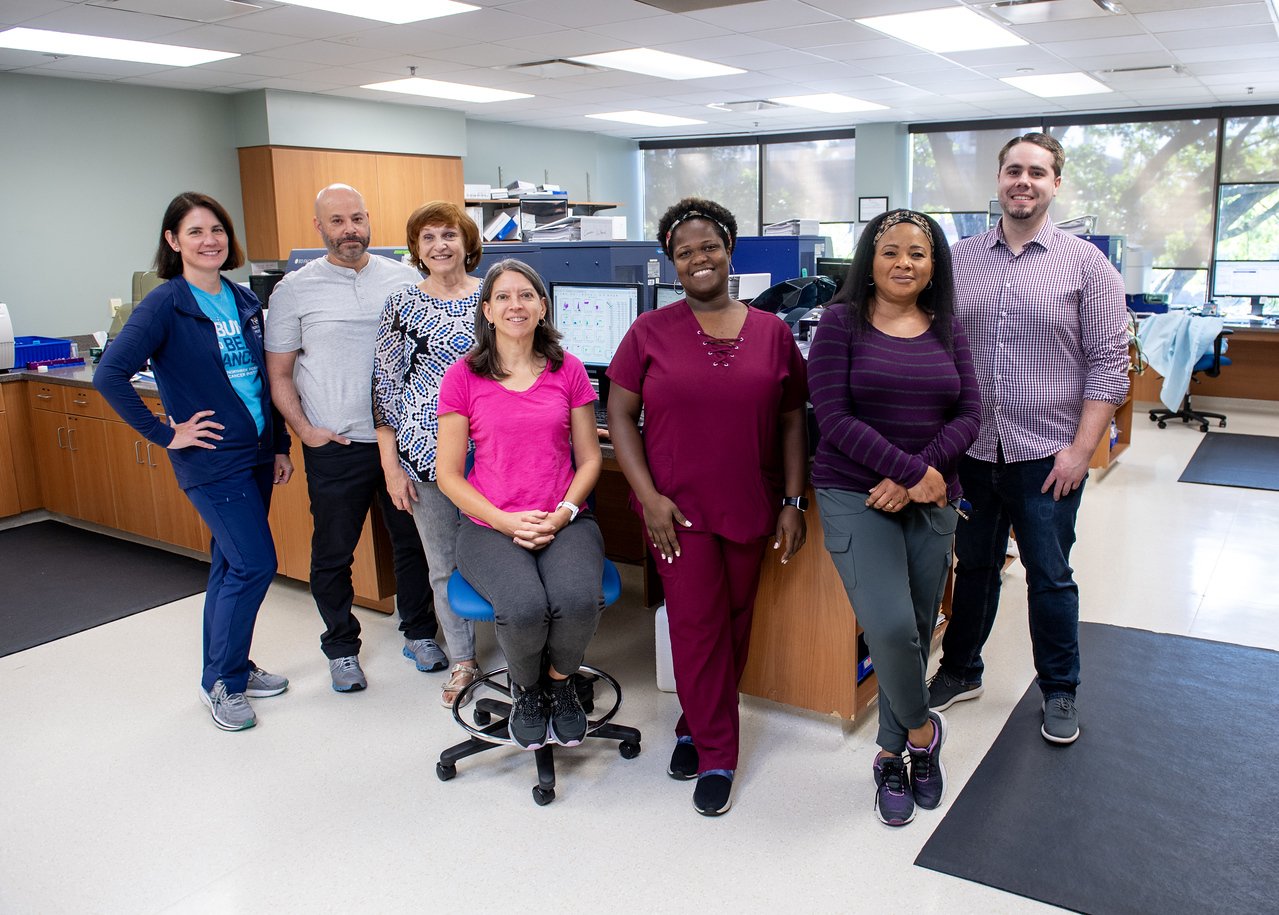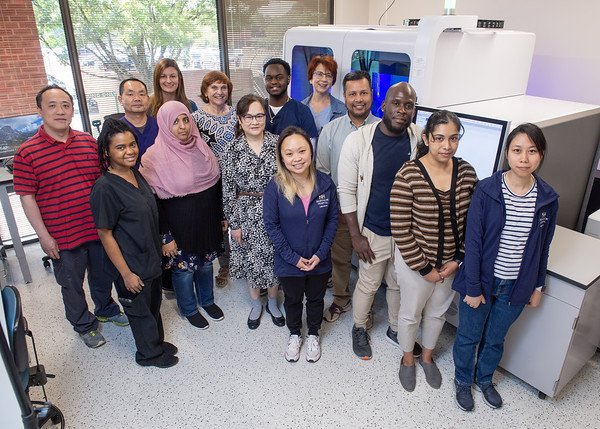
Northside Hospital Flow Cytometry and Molecular Diagnostics Laboratories
Learn More about our Facilities:
Northside Hospital Blood and Marrow Transplant, Leukemia and Immunotherapy Unit
Northside Hospital Hematopoietic Stem Cell Processing Laboratory
Northside Hospital Flow Cytometry and Molecular Diagnostics Laboratories
Diagnostic testing available to the blood and marrow transplant/leukemia/immunotherapy patient
NH Flow Cytometry and Molecular Diagnostics Laboratories, under the direction of Irina Grigorieva, PhD, perform high-complexity clinical assays by utilizing innovative equipment and progressive technologies in their 7,000 square feet of state-of-the-art facilities. They provide outstanding customer care by assisting clinicians with diagnostic work-up testing, determining disease prognostic indicators, quickly identifying early relapses, and providing post-treatment assessment and diagnosis.
Both laboratories meet the requirements of CLIA, the Georgia Department of Human Resources, JCAHO, and the College of American Pathologists.
Available flow cytometry services
10-color immunophenotyping for evaluation, diagnosis and monitoring of hematologic malignancies
Comprehensive and custom-designed antibody panels for flow cytometric analysis
Expression analysis of surface and cytoplasmic antigens
Lymphocyte subset typing for measuring the absolute counts and percentages of major lymphocyte populations (T cells, B cells, and NK cells) in peripheral blood. This crucial diagnostic tool monitors HIV, immunodeficiencies, and autoimmune diseases.
Enumeration of CD34-positive precursor stem cells for transplanting leukemic patients
Minimal residual disease flow cytometry testing is now available:
Minimal Residual Disease in Multiple Myeloma—the test is developed based on the European Myeloma Network (EMN 2013) and Consensus Guidelines of the International Clinical Cytometry Society (ICCS 2016). The lab-developed assay is validated for 10 antigens, detection of the clonal plasma cells with LLOQ of 0.01%
Minimal Residual Disease in B-cell Acute Lymphoblastic Leukemia—a powerful predictor of outcome in acute leukemia—is used in therapeutic stratification for acute lymphoblastic leukemia protocols. The test is developed, and the analysis is performed based on recommendations and the Method Summary of Children’s Oncology Group COG protocols, based on 13 antigens analysis with the levels of detection of B-lymphoblasts 0.02% (LLOQ) and 0.002% (LOD)
Available molecular diagnostics services
Pre-transplant genotyping of leukemia patients and donors
Post-transplant engraftment follow-up by micro-chimerism assay
Monitoring of CMV viral load post-transplant
BCR-ABL1 fusion transcript analysis by qRT-PCR
JAK2 V617F mutation analysis by qPCR
Minimal residual disease molecular diagnostic testing is now available:
NPM1 (nucleophosmin) gene analysis, exon 12 variants. detected in about 30% of adult patients diagnosed with primary Acute Myeloid Leukemia (AML). This is a useful marker for minimal residual disease (MRD) monitoring in AML.
FLT3 Mutations Analysis—detects internal tandem duplication (ITD) mutations and mutations in the tyrosine kinase domain (TKD) of FLT3 in acute myeloid leukemia (AML). The presence of these mutations in AML provides prognostic information and can aid in the determination of a therapeutic regimen. This assay is added for the myeloid NGS panel to compensate for limitations of NGS technology in detecting long DNA inserts.
NGS (Next Generation Sequencing)-based assays for diagnostics and monitoring of acute leukemia and myeloproliferative neoplasms are now available:
NGS panel for myeloid leukemia—a panel of 43 genes involved in differentiation pathways of myeloid lineage, a combination of hotspot mutational regions and full coding regions. Offered for sensitive mutation screening in bone marrow and peripheral blood samples.
NGS panel for screening myeloproliferative neoplasms—sub-panel, limited to screening of driver mutations commonly detected in myeloproliferative neoplasms: JAK2, CALR, and MPL
NGS panel for identification of RNA Fusions, KMT2A-PTD, and MECOM expression